
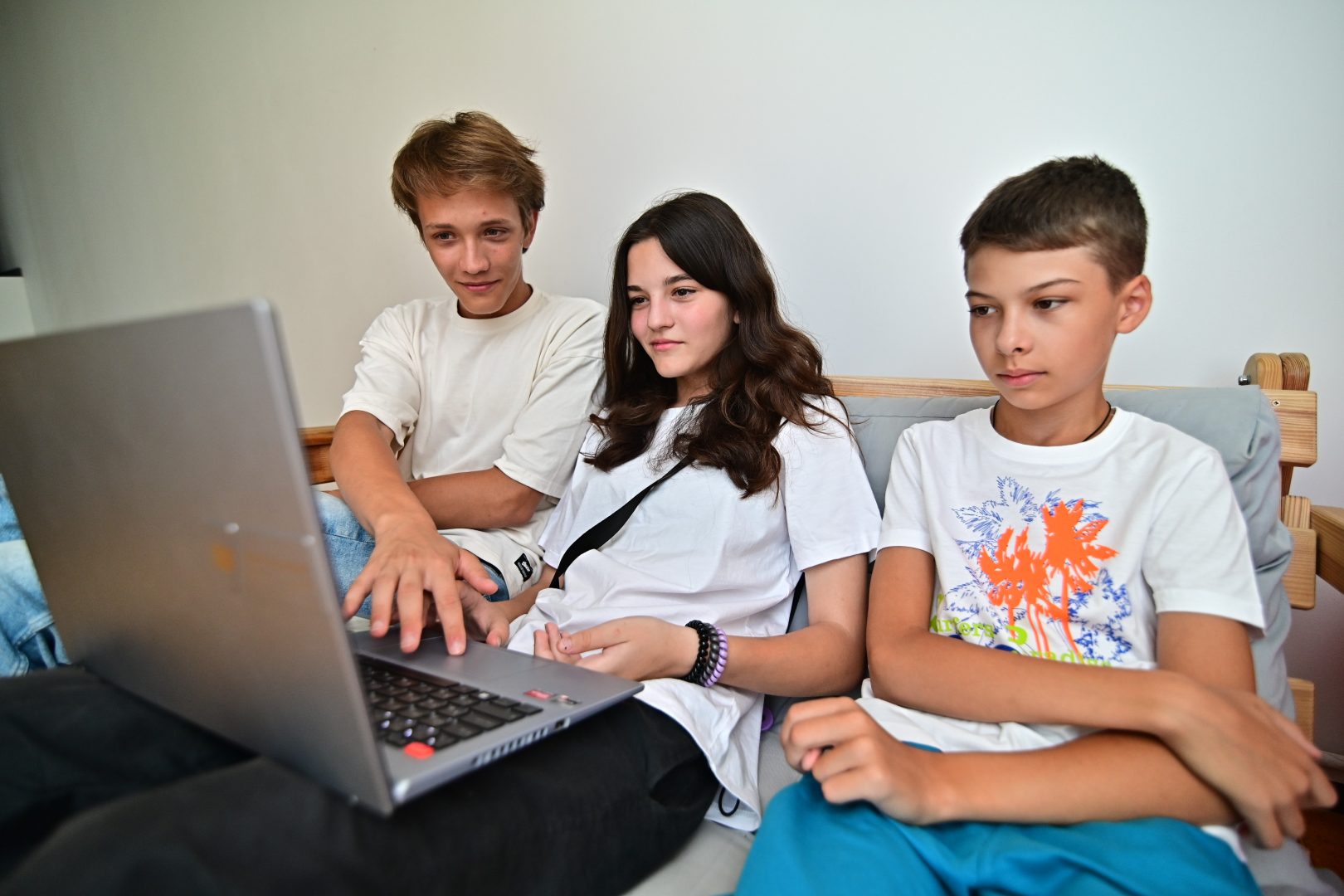
The localization team behind Khan Academy, one of the world’s leading international online platforms, has translated and adapted 7 additional educational courses in mathematics, chemistry, biology, and economics. Ukrainian schoolchildren can now access 12 free, interactive courses in Ukrainian on uk.khanacademy.org. The project is being implemented by the KSE Foundation in collaboration with faculty and students from KSE University, Taras Shevchenko National University of Kyiv, and Igor Sikorsky Kyiv Polytechnic Institute.
Last year, the project team localized educational content—including lesson notes, tests, and video lectures—for five courses: Algebra Basics, Arithmetic, Precalculus, Basic Geometry and Measurement, and Algebra 2. This year, seven more courses have been made available in Ukrainian for free:
-
Pre-Algebra
-
Early Math
-
High School Statistics
-
High School Geometry
-
Middle School Biology
-
High School Chemistry
-
and two topics from Microeconomics
In total, the newly localized content includes about 600 lessons and 160 hours of recorded video.
Today, every Ukrainian student already has free access to 12 courses on one of the world’s best online learning platforms — Khan Academy. The platform is interactive and enables students to catch up on their knowledge in math and science.
Thanks to the newly localized math courses, young learners can now study online how to count, add, subtract, measure lengths, build charts, and explore geometric shapes. Middle school students can access video lessons on identifying divisors and multiples, factoring numbers, and working with percentages. The statistics course is designed for high school students to teach them how to analyze graphs, calculate mean, median, and understand distributions. Also for high schoolers, the geometry course now covers transformations and their properties, basics of trigonometry, analytic geometry, and 3D geometry.
Online chemistry lessons help students deepen their understanding of atomic structure, isotopes, chemical reactions, and intermolecular forces. Meanwhile, the biology course for middle school students introduces topics like photosynthesis, evolution, and the development of various living organisms. The introductory microeconomics course, currently featuring two topics — “Basic Economic Concepts” and “Supply, Demand, and Market Equilibrium” — explains in simple terms the core principles and functioning of the economic system.
Over 70 specialists have contributed at different stages of this Ukrainian localization project. This includes translators, voice-over actors, content reviewers, editors, pre- and post-production experts, curriculum developers, and volunteers. The math curriculum is already available on the platform, organized by school grade levels according to Ukraine’s national curriculum. Very soon, new courses such as High School Biology and High School Physics will be added.
Moreover, since March 17, Khan Academy has launched a Ukrainian National Multi-Subject Test (NMT) prep course, specifically designed for students preparing to enter higher education institutions in Ukraine.
Future plans include localizing lessons in mathematics, engineering, natural sciences, economics, and computer programming for both students and teachers. The project’s goal is to make world-class STEM education accessible and engaging for every child in Ukraine, especially those who are abroad or unable to attend school due to the war.
About Khan Academy:
Khan Academy is a U.S.-based nonprofit organization that develops educational online content. One-third of U.S. students use the platform, which is available in over 40 languages and has 165 million registered users in 190 countries. Khan Academy is supported by Google, the Bill & Melinda Gates Foundation, and international donors. The platform is designed not only for students but also to support teachers and allow parents to monitor their child’s progress.